Friday, March 8, 2013
Guatemala’s Lomas de Tzununá: Tranquil Inn Boasts Volcano Views
Saturday, December 1, 2012
Charlie Trotter’s: Marketing Misfire?
Sunday, April 1, 2012
A Villa in Provence: Cliché, but Worth the Effort
Okay, I admit that renting a villa in Provence seems a bit cliché. And I suppose it shows a complete lack of originality to rent one in order to fulfill a fantasy inspired by Peter Mayles’ A Year in Provence (AYIP)—that blockbuster travelogue from the 80’s that’s blamed for spawning a writing genre and a tidal wave of tourists that washed through the once sleepy towns of the southern French countryside.
While a trip to this sunny region of France might seem unoriginal, the trip I took there with a clutch of family members was anything but.
For starters, instead of opting for the more popular and crowded towns near Aix (these being the ones featured in AYIP, scores of travel articles and the Michelin guide), we booked a rambling, renovated farmhouse outside of Sablet near Gigondas. Haven’t heard of Sablet or Gigondas? Well, many haven’t. And traveling to these small towns means you avoid crowds, movie stars and jacked up prices.
Sure, renowned markets, restaurants and food shops reside further to the south and east, but in this sleepier corner of Provence there’s plenty of good food, sublime scenery and quaint villages in which to park your derriere. Rhones—those delectable, earthy red wines—are made hereabouts and there are plenty of tasting rooms and wineries to visit—a few with settings that make a visit worthwhile for even wine-haters (try Domaine de Coyeux, situated on a mountaintop near Beaumes de Venise). Besides, the Michelin-starred spots in the more cliché part of the country had received bad press, so we decided to sniff out some less celebrated spots.
Within 30 minutes drive of our farmhouse in Sablet (scorpions included—the sort that merely sting like a bee, the villa caretaker assured) were a number of spots worth a visit.
Vaison-la-Romaine, a charming jumble of stone and terra cotta tile covered buildings which clings to and nestles beside a mountainside, affords views of the Rhone Valley, cobblestone streets and little else. There are few tourists, only a restaurant or two, and even some abandoned, crumbling homes. From the almost painfully charming upper village you can overlook an ancient stone bridge that spans a deep chasm far below and hike through winding streets until you reach a ruined castle.
Further west, the ancient theater in the otherwise charmless and petite city of Orange is worth a visit. Rising monolithically from a drab area of town, the aged stone structure is more intact and unusual than any similar Roman structure—including Rome’s Coloseum. While the relic is the only thing worth seeing in Orange, the same doesn’t hold true for nearby Nimes—where I could have spent a week. From its petite and well preserved arena to the artisan Boulangerie Villaret—founded in 1775 and packed with golden-crusted breads and flaky pastries, Nimes packs culture, architecture, history, and charm into a compact center.
Nearby, interesting shops, cafés and restaurants line the streets around Europe’s only intact Roman temple—the exquisite Maison Carrée. A short distance outside Nimes stands a massive, intact Roman aqueduct, the Pont du Gard.
More heavily touristed Avignon with its splendid and rambling papal palace, sidewalk cafés, and squares merits at least an afternoon. If you’re not up for exploring the enormous palace, grab a seat in one of the many cafés on the square fronting it. Order a local Cigales beer and soak up the atmosphere and a killer view of the palace.
And what about those less-celebrated eateries?
On the edge of Sablet where the village melts into vineyards you’ll find the diminutive Les Abeilles which boasts an outdoor dining terrace that smacks of a Provencale photo shoot: giant plane trees with spreading branches, tufts of blooming lavender, a boules court, and a tall, sturdy wall that surrounds it all and provides privacy from the nearby road. It’s tough to beat lunch here on a sublime Provencale day when a few rays of warm, golden sun penetrate the leafy tree branches, a slight breeze blows and a bottle of local rosé sits before you. And that’s before delicious plates of escargot, roasted lamb or chicken, or mushroom tarts land on your table. The only thing better than lunch on the terrace here is, well, dinner.
Les Florets, in nearby Gigondas, boasts one of the most idyllic terraces in all of France. Embraced by forest-cloaked hills, the restaurant serves traditional French fare and offers one of the most extensive local wine collections in the area. Visit just before sunset to watch the green hillsides glow amber as twinkling stars emerge and strings of lights in nearby trees blink on.
For a fine dining experience, we visited the much-celebrated l’Oustalet which is situated right on the sleepy square in the tres petite village of Gigondas. The only mistake you can make here is to order too much (well, and to park your vehicle at the edge of a dimly lit lot and so have your rental car broken into.) The food is crazy good and prices reflect that. Order a full menu, sure, but I’d recommend omitting the cheese course which we all agreed was one incredible dish too many. Instead, order one cheese plate for the table so as to at least be able to sample the incredible offerings here. Local truffles, rich, buttery slabs of foie gras, roasted pigeon, and tea-infused salmon are a few of the possibilities. Reservations are essential.
On the eastern flank of the Dentelles de Montmirail in Crestet, you’ll find Le Fleur Bleue, a half gypsy, half shabby chic spot in a somewhat renovated former barn. Whitewashed walls, scores of candles, fresh picked wild flowers, and a small, but well executed menu comprised of mostly French bistro classics make for a memorable meal.
For more recommendations, write me a note. For inspiration, read A Year in Provence. To rent a villa, check out Gite.com.
Thursday, November 18, 2010
Intoxicating Vanilla
One of my favorite childhood memories was watching my mother bake. And perhaps even more enjoyable were the scents that wafted out of the kitchen. Sometimes my mom allowed one of us kids to help her with some simple task, such as pouring a spoonful or two of vanilla extract into whatever batter she was mixing.

Even as a child, the scent of that vanilla was intoxicating. The simple act of unscrewing the cap on the dark brown bottle released its heady perfume. I’d been tempted to drink the stuff, so appealing was its smell, but either my mother talked me out of it or I was suspicious of its dark, syrup-like appearance.
These days, I’m still tempted to drink the stuff—or to eat a vanilla bean whole—but I no longer find the stuff suspect whether it’s in solid or liquid form. All that matters is that it be pure.
Like so many other things, Americans are discovering that pure foods have more flavor than their artificial counterparts. Some years ago, many a prudent baker might have eschewed pricey pure vanilla for its cheaper, imitation counterpart. Well, not any longer.

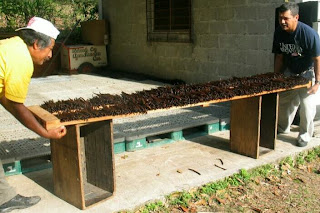
And there are options available today that weren’t widely available even a dozen years ago. When I was a kid, only vanilla extract was available. Currently, you can find dried beans from any of the four spots vanilla is grown: Mexico, Madagascar, Indonesia and Tahiti. Vanilla from the former two is considered superior, while that from the latter two is generally weaker in flavor and fruitier. For an aromatic and flavor-packed addition to a dessert, whole beans can be shaved or ground over ice cream, cake, fruit or added to whipped cream for an aromatic and flavorful addition.
The story of vanilla reads like an epic novel, with idiosyncratic aristocrats, an enterprising slave, bandits, tycoons, Aztec kings and simple farmers. Vanilla, which originated in Mexico, is grown successfully in only a few areas of the world. Produced from the dried pods of a flowering orchid vine, vanilla is as difficult to cultivate as it is tasty. For an enlightening read on the history of vanilla, check out Tim Ecott’s Vanilla.
If you’d like to get some pure vanilla extract or beans, you can find them at many grocery stores. And some of the premium extracts, such as Nielsen-Massey’s (one of the largest purveyors of pure vanilla and located in suburban Chicago) can be found at Williams-Sonoma or on-line. Another good source is the Spice House or many Whole Foods locations.
While vanilla is one of the priciest flavorings in the world, most people involved in the business of growing, buying and selling the beans aren’t making much money. One of the reasons vanilla is so costly is because each flower must be hand pollinated, a tedious and intensive task which is largely performed by farmers who live a simple existence. It’s the painstaking process of growing, drying and shipping this extraordinary, flavorful bean that makes it so expensive—but ultimately worth it.
Photos Courtesy Vanilla-Trade
Monday, August 23, 2010
Want the Largest Farmer's Market in America? Head to Madison.
Most people think the largest farmer’s market is somewhere in California. Or perhaps New York City. But it’s not.
And the setting actually makes sense because the Dane County Farmer’s Market is surrounded by the largest concentration of organic farms in the country which means there’s plenty of tasty produce and food products from which to choose.
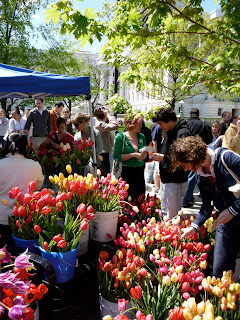
But small scale and organic farmers aren’t the only vendors filling the wide sidewalks that circle Wisconsin’s towering capitol building (which is just a few feet shorter than the U.S. Capitol after which it was modeled). Hmong and Swedish farmers, venison and grass-fed beef vendors, and dozens of other food producers fill the block.
Held on Saturdays from April through November (when it’s much reduced in size and moves indoors), the market boasts over 300 vendors, with around 150 participating during the weekly market.
Farmers markets have become so trendy that some less authentic versions and, well, unsavory vendors have gotten into the game. (Telltale signs?—bananas, out of season fruits and veggies, or perfectly packaged items.) Thankfully, Madison’s farmer’s market prohibits re-selling. If it’s for sale at the market, then it was grown or made in Wisconsin.
Market days resemble a giant outdoor party more than a market. Corn on the cob, tacos, pad thai, gyros, and many other prepared foods can be purchased from food carts. Sometimes there’s even beer (this is Wisconsin, after all.)
While foodies might swoon or stumble given the incredible array of fresh produce, flowers and locally-crafted food, they just need to be sure to follow one rule: move counter-clockwise.
That’s right. Given the enormous flow of pedestrian traffic at this mega-market, everyone walks around the Capitol Square in a counter-clockwise direction.